Thursday, 2 January 2014

Central Bank of Bitcoin


THE BITCOIN CENTRAL BANK’S PERFECT MONETARY POLICY

The following post provides an analytical framework so that critics and proponents of Bitcoin’s monetary policy can engage in a constructive debate.
Bitcoin has a central bank called the “Bitcoin network,” which we will refer to as the Bitcoin Central Bank (BCB). This central bank issues a currency called “bitcoins” and processes the transfer of bitcoins between accounts. The BCB’s rule-based monetary policy was set at its creation and its independence is secured by the distributed nature of the underlying network. This non-discretionary monetary policy can best be described as asymptotic money supply targeting (AMST).
amst
The BCB issues bitcoins to a network of sub-contractors called “miners” who perform the proof-of-work calculations that secure the BCB’s independence and process payments. The seigniorage subsidizes the payment system instead of benefiting the issuer or the seller/recipient of bonds transacted in open market operations. Proof-of-work seigniorage (PoWS) and AMST work synergistically to cause three monetary phenomena:
  1. Rational economic agents hold a balance of bitcoins even if they have no bitcoin-denominated liabilities.
  2. The market sets exchange rates and interest rates, without exception.
  3. Fractional reserve banking cannot develop, so liquidity traps are impossible.
First, it is rational for economic agents to hold as many bitcoins as they can afford to lose (i.e. without materially impairing their ability to consume or invest). The BCB can offer lower transaction costs than any competitor by orders of magnitude because of the PoWS subsidy. This deep competitive advantage gives economic agents the expectation that it will be adopted as a method of payment and that its exchange rate liquidity will increase. This expectation has repeatedly proven to be true so the desire to hold bitcoins has increased, as indicated by the exchange rate and Internet search volume.
transactioncosts
The Market Sets Exchange Rates and Interest Rates
The exchange rate volatility is a byproduct of the BCB choosing independent monetary policy (AMST) and free capital flow over a fixed exchange rate within the Impossible Trinity. Economic agents overcome their cognitive biases to acquire bitcoins in waves due to the word-of-mouth marketing of the currency. For some it takes one exposure to Bitcoin to “get it” while others follow the lead of trendsetters or finally succumb to their regret-aversion bias. Either way, these waves of adopters have a destabilizing effect on the exchange rate: speculators are unsure of the amplitude or wavelength of adoption, and amateurish punters let their excitement as well as subsequent fear overwhelm them. The BCB does not intervene to stabilize these intermittent hype-cycles because steady appreciation of the exchange rate would allow for an even greater buildup of speculative excesses and the BCB would lose the confidence that AMST gives to long-term holders of bitcoins.
Bitcoin’s interest rates are based on the arbitrage between the expected return of holding bitcoins versus the expected return of lending them out. The expected return of holding bitcoins is completely tied to its expected future exchange rate because bitcoins are currently a pure vehicle currency. The heterogeneous expectations of bitcoin holders regarding the exchange rate has led to the development of marginal lending operations. However, the vast majority of bitcoin holders expect exchange rate appreciation at rates far greater than any borrower is willing to pay. Bitcoins will continue to be hoarded and bitcoin-denominated credit markets will continue to be under-developed until either the expectations of bitcoin-holders adjust downward or are met. The BCB does not need to take action to break the current equilibrium state since the hoarders’ expectations will be met given Bitcoin’s proven superiority to legacy payment networks and stores of value.
bitcoinfeedbackloops
Fractional Reserve Banking Cannot Develop
Fractional reserve banking entails the creation of new money that is fungible with already preexisting money, i.e. it can be used interchangeably within the currency’s payment systems. This is impossible with Bitcoin. The BCB enforces the strictest deposit regulations in the world by requiring full reservesfor all accounts. This is the digital equivalent of the Chicago Plan or the Austrian 100% reserve gold standard. Under this regulatory regime, money is not destroyed when bank debts are repaid, so increased money hoarding does not cause liquidity traps, instead it increases real interest rates and lowers consumer prices. This is a self-stabilizing cycle as higher interest rates incentivize hoarders to invest, while deflation increases consumption due to the wealth-effect on hoarders. The BCB prevents lending out of deposits so that it can properly target money supply and avoid the destabilizing effects of commingling the credit and payment systems.
The positive properties of AMST and PoWS combined make it certain that, absent a technological problem, Bitcoin will be adopted as the global currency. For a deeper understanding of the market process involved in becoming global currency I would recommend reading Konrad Graf’s explanation ofhyper-monetization and Peter Šurda’s liquidity analysis of bitcoins. The Bitcoin Central Bank will be the longest lasting institution of its kind thanks to the anti-fragile independent monetary policy it has set in stone.

Wednesday, 1 January 2014

Credit card security is broken. Here’s how Bitcoin could help fix it.

BY TIMOTHY B. LEE
My wife and I are planning a trip to Asia in January, and so I've been making hotel and airplane reservations. In the process, I've had first-hand experience with the dysfunctional state of international credit card payments. I've had three transactions declined on spurious security concerns, and each incident has required a call to my bank to correct the problem.
A common criticism of Bitcoin holds that the Internet-based payment network isn't actually useful. Sure, Bitcoin allows people to transmit value electronically, they say, but conventional payment networks like MasterCard already do that.
But the clumsiness of international credit card transactions, not to mention Target's recent security woes, provide good illustrations of how better payment technologies could be beneficial. As we'll see, a Bitcoin-based alternative to conventional credit card networks could be significantly more secure and, as a result, more convenient and affordable for everyone.
But getting there would be tricky. Fees in the credit card network are paid by merchants, whereas the Bitcoin-based payment scheme I describe here would have consumers paying by default. The Bitcoin community will have to figure out how to shift fees back onto merchants if it wants to attract enough users to make Bitcoin-based payments mainstream.
A 20th-century payment network
My efforts to buy Asian plane tickets went like this: I went to an airline's Web site to make a purchase. The bank that issued my credit card flagged the transaction as suspicious and refused to honor it, leading to a cryptic error message on the airline's Web site.
I called my bank. After verifying my identity by asking me some not-very-secure "security questions," the bank representative told me the bank had denied the transaction as a security precaution. I assured him that the purchase was legit. He cleared the hold on my account and asked me to resubmit the transaction.
In the last week, I've gone through this process not once, but three times. Each time I've called the bank, I've asked them to update my account to make sure my transactions with Asian hotels and airlines don't get blocked. They haven't been able to do it, forcing me to make multiple, time-consuming phone calls.
In the age of the Internet, this is a crazy way to run a payment system.
Chicken and egg
The fundamental problem with conventional payment networks (mine was a MasterCard, but other credit card networks work similarly) is that they try to detect fraudulent payments without the active participation of the card holder. If the credit card network wants to know if a payment from my account is legitimate, the best way to find out would be to ask me.
When the credit card was created decades ago, there was no practical way to do that. So, instead, credit card companies try to guess which transactions are legitimate using characteristics of the transaction, such as the country it was made in and the size of the purchase. That's an inherently error-change process.
Happily, the world has changed. Today, most people have Internet-connected smartphones in their pockets. In principle, it shouldn't be difficult for users to confirm payments at the time of sale, nipping most credit card fraud in the bud.
Indeed, there are products like Safepay that do just that. But they face a huge collective action problem: They only work if both merchants and customers adopt them. Safepay requires merchants to sign up with a $15 per month account. And it requires customers to download the Safepay app so they can confirm transactions.
As long as few merchants are Safepay users, there isn't much incentive for customers to download the app. And with few customers using Safepay, there's little reason for merchants to adopt the system. So far, no Safepay-like product has become widely adopted.
That's one example of a general problem with credit card security: Responsibility for credit card fraud is divided among merchants, card-issuing banks, the credit card network itself and users. That diffusion of responsibility, as well as the complexity of the credit card networks' rules (Mastercard has hundreds of pages of regulationsgoverning transaction disputes), make the system hard to improve.
Why Bitcoin is different
The Bitcoin network operates differently from conventional payment networks, and those differences could allow the Bitcoin community to develop more effective anti-fraud techniques. Conventional payment networks place most of the liability for fraudulent transactions on the merchant, allowing customers to challenge and reverse suspicious payments. Bitcoin, however, puts all of the liability on the payer. If you get tricked into sending a payment to the wrong person or hackers steal your Bitcoins, you have no recourse.
That allows for much simpler rules for the Bitcoin network compared with conventional credit card networks. Many of the regulations that govern Visa and Mastercard are designed to prevent misuse of the network and to protect consumers. Bitcoin operates on a buyer-beware basis. That might not be good for consumers (we'll get to that in a minute), but it makes the Bitcoin network much more hospitable to innovation.
It's obvious why merchants would be drawn to this kind of system. Accepting Bitcoin payments means lower fees, fewer regulations and no worry about liability for fraudulent transactions. Bitcoin transactions are irreversible. Once you've received a Bitcoin payment, you don't have to worry about it being challenged and reversed. Bitcoin's merchant-friendly approach may explain why the number of Bitcoin merchants has been soaring.
What about customers? At first blush, shifting liability to the customer isn't a consumer-friendly move. And the bare Bitcoin network isn't at all hospitable to ordinary users. Securing a Bitcoin wallet is tricky, and people who store their wealth in bitcoins risk having the value of the currency suddenly plunge.
But Bitcoin is an open platform that others can build on. Just as companies like Bitpay and Coinbase help merchants accept bitcoins with minimal hassle, so consumer-oriented startups may be able to help users spend bitcoins securely. Just as Bitpay and Coinbase allow merchants to immediately convert Bitcoins back to conventional currencies to protect against the risk of Bitcoin's volatility, so a customer-focused Bitcoin payment service could hold customers' cash in conventional currencies and convert them to Bitcoin at the time of payment. They should also be able to offer the same liability protection as banks and credit cards: that the company, not the customer, will be liable for the costs of hacking, fraud and other security issues.
Who should pay?
Of course, these services won't be free. But they could be pretty affordable. One of the biggest expenses of this type of consumer-facing Bitcoin payment service would be reimbursing customers for fraudulent transactions. That means that the fees a Bitcoin payment service would need to charge would depend primarily on how secure it is.
Bitcoin-based payment services would have both the authority and incentive to improve the security of their apps and pass those savings on to customers. For example, one of the best ways to boost the security of a payment app is to use anauthentication token, a keychain-sized device that provides a "second password" that changes every minute or so. Users typically resist carrying such a device, but some might change their tune if a payment service offered them a significant discount for doing so.
A well-designed payment app could be cheap enough that customers with unusual needs would be willing to pay for them. International travelers, for example, might be willing to pay a modest fee to never have to worry about their transactions being declined or getting hit by unexpected fees. At the opposite end of the spectrum, some consumers who lack credit card and bank accounts are forced to pay their utility bills in cash. They might find Bitcoin-based payment services a convenient alternative.
Of course, to be truly mainstream, Bitcoin-based payment systems would need to match the zero-fee principle of the conventional payment network. Bitcoin is such a good deal for merchants — they save the roughly 2 percent credit card fee, and they don't have to worry about charge-backs — that it might make business sense for them to offer customers a discount of 1, 2 or even 3 percent if they paid with bitcoins and still come out ahead compared with the cost of accepting credit cards.
The open payment network
Obviously, I'm doing a lot of hand-waving here. Much of the infrastructure I'm describing doesn't exist, and my specific predictions will probably prove to be wrong. But the market structure I'm describing illustrates an important strength of Bitcoin. Conventional payment systems are monolithic. Everyone is required to use the same procedures, limiting experimentation. But Bitcoin gives users, and the firms that send and receive payments on their behalf, a lot more flexibility. Over time, we should expect that freedom to foster greater experimentation and quicken the pace of innovation.
Something similar happened in the telecommunications industry. Since the mid-19th Century, the world's telecommunications infrastructure had been managed by the International Telecommunications Union. The international body ensured that communications networks could interoperate by requiring them to adopt shared standards.
By the 1970s, this system had produced a sophisticated system of phone and telegraph networks, but it was also beginning to show its age. New telecommunications services required buy-in from national telecommunications monopolies, which meant that progress was slow. Fees for long-distance communications were high.
The Internet upended that system by adopting a much simpler set of rules. Rather than trying to specify which features Internet-based networks must provide to their customers, the Internet's core protocols simply provided a basic ability to transmit data and left individual users the freedom to build more sophisticated services using that basic communications capacity. Initially, the Internet was dramatically inferior to conventional communications networks, but over time Internet applications became increasingly sophisticated. Today, the Internet's capabilities are much greater than those of the conventional services overseen by the ITU.
Bitcoin applies the same philosophy to payment networks. Rather than trying to build every feature into the core protocol, the creator of Bitcoin defined a simple, flexible way to transmit money. The system leaves it to others, like Bitpay, Coinbase and firms that haven't been founded yet, to build secure, user-friendly payment applications on top of that basic infrastructure. It's impossible to predict what those services will look like or whether consumers will prefer them to conventional payment networks. But history suggests that Visa and Mastercard shouldn't get too comfortable.

Tuesday, 31 December 2013

Bit Coin comes back with a rally of 79% increase in under two weeks


That Giant Bitcoin Crash in the Wake of China Restrictions? It Never Happened.

bitcoins
When news surfaced two weeks ago of a fresh round of restrictions that China was placing on businesses transacting in the bitcoin ecosystem, the value of bitcoin plummeted.
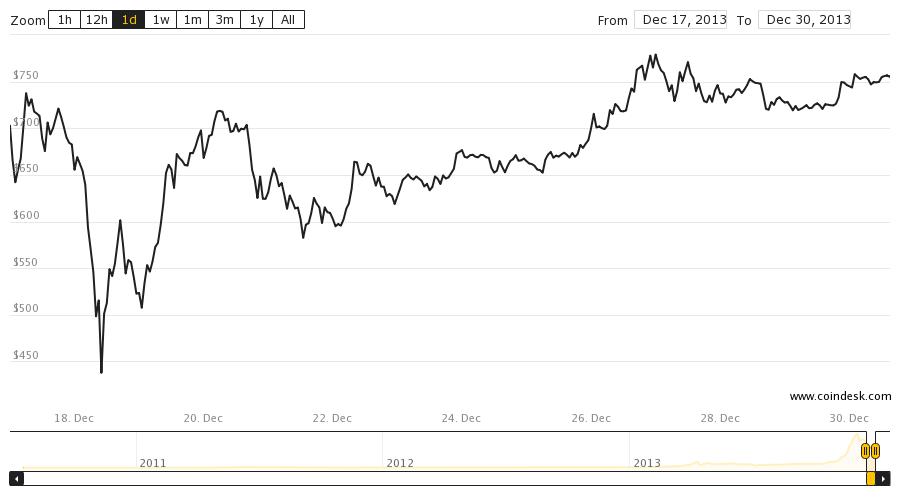
The CoinDesk Bitcoin Price Index, for example, showed that bitcoin traded as low as $422 around Dec. 18, when the large Chinese exchange BTC China acknowledged that it wasn’t accepting new deposits in the local currency until it could find a new payment processor that would do business with it.
But a funny thing has happened since then: Bitcoin hasn’t experienced an all-out crash. Instead, its value has recovered. A lot.
As of this writing, CoinDesk’s index, which takes the average of bitcoin trading values from three global exchanges (not including BTC China), pegs the value of bitcoin at about $755. That’s a 79 percent increase in a little less than two weeks.
coindesk-bpi-chart
The digital currency is trading a bit lower on BTC China, which still isn’t accepting new deposits, at about $723, but its value has recovered a bunch in the last two weeks.
So, is bitcoin suddenly so resilient that one government’s restrictions can’t topple the whole ecosystem? Or are there artificial safeguards propping the value up? It could be a combination of two.
On one side, it’s clear bitcoin demand has increased across the globe in recent months. But at the same time, BTC China has instituted some changes to its business in the last two weeks, in what seems like an attempt to keep its users from fleeing, that may be affecting pricing.
BTC China CEO Bobby Lee published a post on Dec. 20, the day after he told AllThingsDthat he was still searching for a way to take new deposits and keep his exchange afloat, outlining some changes to the exchange.
The first was a bitcoin wallet that the company says would keep customers’ bitcoin stored safely.
The second change was reinstituting trading fees that had been waived for some time, in an effort to “reduce speculation and price volatility.”
“We strongly believe that the regulators want to see Bitcoin develop in a more stable manner in China, without the high volatility in prices,” Lee wrote. “We believe that Bitcoin can continue to thrive in China if the prices are more stabilized.”
Whether that’s the case remains to be seen. Of course, few people would argue that the volatility in price is a good thing for a more mainstream adoption of bitcoin as a payment method.
Either way, the last two weeks have proven one thing: Bitcoin is a lot harder to topple than almost anyone could have expected just six months ago.

Common Bitcoin Misconceptions


A number of Bitcoin misconceptions are seen in news stories, reports, and discussions.
Bitcoin is a currency, commodity, and a payment system.  Bitcoin is a currency that can be traded for goods and services.  It is also possible to invest in Bitcoin and trade for other currencies.  Since Bitcoin is essentially “programmable money,” and can be sent to someone through the Internet like an e-mail, it is also a payment system.
Bitcoin is also an underlying protocol.  This protocol may morph into something that looks very different that what is seen today.  It has been compared to looking at the early Internet protocol in the early 1990′s.

Confusing Bitcoin wallet and Bitcoin address.  A Bitcoin address is a single address and any balance can be seen publically on the Bitcoin Blockchain ledger.  A wallet is normally a collection of Bitcoin addresses.  A wallet is not on the public Bitcoin Blockchain ledger.  The wallet compiles the balances of the Bitcoin addresses in the wallet but that is done of the local computer and not on the public Blockchain ledger.  There is no way to tell what addresses are in a wallet unless they are linked in some way.  This commonly happens when making a payment where the total is taken from more than 1 address in the wallet.

You don’t need buy or transact a whole Bitcoin.  Bitcoin has 8 decimal digits and can be broken down to 0.00000001 which is called a Satoshi.  MilliBitcoin or MillyBits will most likely be the common denomination used in the near future.

There are only 21 million Bitcoins to be produced and some think there are not enough to go around.  Bitcoin has 8 decimal digits and can be broken down to 0.00000001 which is called a Satoshi.

Bitcoin capitalization and plurality.  Bitcoin is capitalized when referencing the protocol or the system in general and not when referencing specific bitcoins.  Some users always use singular when identifying bitcoins even if it more than one, other users use plural when discussing more than one.  “My Bitcoin wallet has 3 bitcoin(s).”  None of the rules are formal since there is no central authority to set any rules.

The Market Cap is not the total number of Bitcoins multiplied by the current trading price.  When Bitcoin was new many users deleted their wallet or wallets were lost/destroyed.  A significant (but unknown) number of Bitcoins have been lost and cannot be recovered and are not in circulation.  Of course if large numbers of bitcoins were sold at once the price would drop (which is true of any commodity).

Bitcoin protocol does not use encryption and no data is encrypted.  The Bitcoin protocol using cryptography, not encryption.  Each Bitcoin address has a “private key” that allows the owner to spend the bitcoins.  The is derived from public/private key cryptography.
The Bitcoin Blockchain ledger is not encrypted, it is fully visible to everyone as it must be in order to verify transactions.
Some of the data in the Blockchain ledger has gone through a cryptographic “hash.”  Sometimes this data is referred to as “encrypted” but that is technically not correct, it is “hashed.”  Encryption is a 2-way function where you can get back where you started if you have the key.  A “Hash” is a 1-way function and there is no key and no way to get back to where you started.
All Encryption uses cryptography.  However, cryptography is wider in scope so all cryptography does not use encryption.  Cryptography used hashes can be used to prove files/messages are not changed from the original.
A wallet that is stored on a local computer has private keys used to spend the bitcoins in the wallet.
A user should encrypt the wallet file for security so if someone gets a copy of it they cannot read the private keys without having the encryption password.

Bitcoin is not necessarily anonymous/all Bitcoin transactions cannot be fully tracked.   Many reports claim Bitcoin is “anonymous” and others say all transactions can be fully tracked and traced.  Neither one of those statements are true in many cases.   Sometimes Bitcoin is described as “pseudonymous” by saying that all transactions are traceable but not necessarily linked to an identity.  While that is technically true it does adequately describe the true situation to most readers.
Bitcoin addresses are long strings of letters and numbers.  A wallet can create as many of these addresses as needed.  However, Bitcoin does something under the hood that most users don’t realize.  The concept is called “change.”  Each Bitcoin transaction must total to zero.  If you have 4 bitcoins in an address and you send 1 bitcoin to someone you have 3 bitcoins left over.  What happens is that a second transaction is set up and 3 bitcoins is set to a new address in your wallet, a so-called “change address.” If someone tries to analyze the transaction from the public Bitcoin Blockchain ledger they cannot tell if the transaction is for 1 bitcoin or 3 bitcoins.  Transactions get split info fingers and it is often impossible to prove which transactions are connected.  Blockchain.info has a number called “taint” where they try to come up with a probability that addresses are linked but it is not conclusive.
change
“Change” Addresses Obfuscate Bitcoin Transaction Tracking


Bitcoins balances do not have to be consolidated.  In almost every discussion of tracing Bitcoin transactions consolidation was either done by the user or it was assumed that consolidation must be done.  For instance, it is assumed that web site that takes payments from different customers during the day must consolidate the payments at some point.  That is not necessary as the wallet program totals the balance of all the addresses.  Users may voluntarily consolidate or they make a large payment where the wallet automatically consolidates the payments.

Blockchain.info web site is not the Bitcoin Blockchain ledger.  They are a web site that compiled the data in the Bitcoin Blockchain ledger and they add several things to the data.  Just because you see something on Blockchain.info does not mean it is in the Blockchain ledger.
These features on Blockchain.info do not appear in the Bitcoin blockchain ledger:
  • Users can set up a vanity display for addresses.
  • Users can attach a message to a transaction,
  • An IP address and location is attached to a transaction (This is the IP of the node where Blockchain.info sees the transaction first, it may have nothing to do with the actual source)

Bitcoin mining is not useless work and cannot be easily converted to do other work.  Bitcoin mining records the transactions and provides security by bitcoins cannot be counterfeited.  Comparing this energy use to other forms of currency and payment systems is rather complicated.  There is physical aspects of traditional currency and fraud/counterfeiting procedures associated with payment systems.
The Bitcoin mining algorithm requires that:
  • The problem cannot be solved in advance (otherwise a fake Blockchain ledger could created offline),
  • The problem has to be hard to solve but easy to verify by home computers, laptops, etc.
  • The average time it takes to solve the problem must be known and controlled.
  • Problems with an unknown solution or something that is computationally hard to verify cannot be used.

Blockchain.info electricity calculations for Bitcoin mining are incorrect.  The site uses and old average based on using graphics cards.  This is no longer done and the newer generation of Bitcoin mining computers use significantly less electricity and it varies greatly between different generations of units.  There is no way to calculate total energy usage.

Merchants are not overly concerned about payment confirmation time.  Transactions on the Bitcoin network are processed immediately but are not “confirmed” until they are included in a “block” which is a section of the Bitcoin Blockchain ledger.  The more confirmations, the more certain a payment will not be revered.  A rule of thumb is to wait 6 confirmations which is 1 hour on average.  While it is possible that this payment could be reversed it is a rather complicated scheme to do so and will only work in a certain percentage of cases.
This issue is only important for transactions where the user is taking the product immediately, such as face-to-face transactions.  One way around this problem is to use “green addresses.”  This is where the merchant trusts the payer’s address.  For instance, a merchant could trust a major online wallet company and if the user sent the payment from their account at that wallet company it could be accepted immediately.

Bitcoin developers cannot autonomously change the parameters of Bitcoin.  Some reports indicate the Bitcoin developers can change the Bitcoin supply by simply changing the software.  The users/merchants decide which version of the software to use and if coins are produced that don’t follow the rules then they cannot be spent.  Developers are testing many variations of Bitcoin (see CoinChoose.com) with different supplies, different mining algorithms, and all sorts of variations.  They are called by different names because they cannot be spent as Bitcoins.

The Bitcoin Foundation does not set the Bitcoin price or peg it to anything.  The Bitcoin Foundation has no special authority over Bitcoin as it is a decentralized system with nobody in charge.  The Foundation was set up by entrepreneurs who run Bitcoin businesses.  The price is free market and is set by what people will pay at various exchanges.

Bitcoin Merchants cannot process transactions faster by mining the transactions themselves.   It is possible to make Bitcoin transactions and not broadcast them to the network.  This means that transactions will only be included in blocks mined themselves.  If the transactions are broadcast to the network then any miner can include the transaction in the next block.  Mining transactions yourself will significantly slow the processing of transactions.

More hashing power on the Bitcoin network does not mean transactions will confirm faster.  Bitcoin is designed so a block is found about every 10 minutes.  More hashing power means it is harder for someone to disrupt the Bitcoin network by mining their own, private Blockchain ledger (If this private ledger became larger that the official ledger it could be released and become the new “official” ledger.  this is a “51% attack.”).  This does not affect the time between blocks which is the confirmation time.

There are no usernames/passwords associated with Bitcoin transactions.  Web wallets will have usernames/passwords but that is not associated with the blockchain.  Wallets may be encrypted by the user for security and require a password but that is not associated with the blockchain.

A Bitcoin private key cannot be “brute forced” from the public Bitcoin address.  Each Bitcoin address has private keys that can be used to spend the funds at that address.  There is no known way to reverse the process to get the private key from the public Bitcoin address  There are way too many keys for modern day computers to be able to “brute force” the private key.
If someone gets a copy of a wallet file that contains private keys it may be encrypted with a password.   It may be possible to “brute force” this encryption password if the password is weak.  This cannot be done from data in the Bitcoin blockchain ledger, the wallet file must be obtained from the user’s computer.